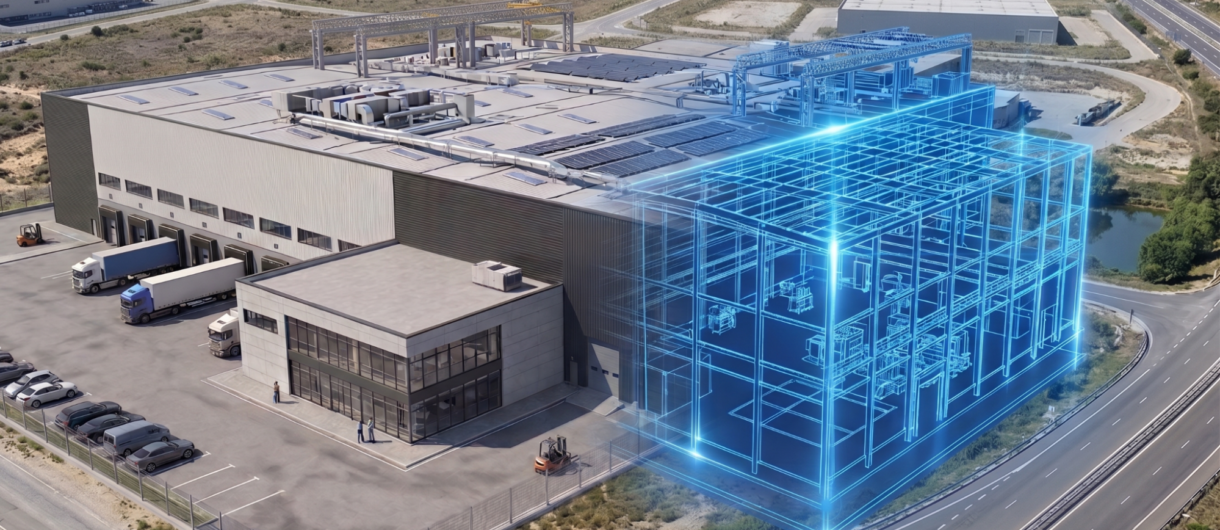
Digital twins in construction: how they improve building design, operation and maintenance
Digital twins in construction make it possible to connect the information generated during design and construction with the real-life performance of the building. Beyond three-dimensional visualisation, their value lies in providing reliable, structured and accessible data to support decision-making throughout the asset’s lifecycle: from project coordination to the maintenance of building services.
What will you learn in this article?
- What digital twins in construction are and what they are used for
- BIM and digital twins: key differences you should know
- How digital twins can contribute to building fire safety
- What a project needs to implement a building digital twin
- What benefits digital twins bring to construction
What digital twins in construction are and what they are used for
A digital twin is a digital representation of a physical asset that brings together geometric, documentary and operational information to facilitate analysis, monitoring and management. In a building, it can integrate the architectural BIM model, building services, technical documentation, maintenance records and, where required by the use case, data from IoT sensors or control systems.
Its implementation should not simply respond to a technological trend. It should begin with a specific need: controlling assets, reducing information loss between project stages, improving maintenance planning or ensuring documentary traceability before a technical intervention. Depending on the building’s level of digitalisation, information may be updated periodically or through connected real-time data.
The recent EN 18162:2026 standard establishes concepts and definitions for digital twins applied to the built environment, reinforcing the need to work with a common language among designers, contractors, owners and building managers.
What data does a building digital twin integrate?
The information should be adapted to the intended use of the digital twin. Not every project requires the same level of detail or the same update frequency.
Generally, a building digital twin may include:
- Geometric models and the location of building elements.
- Technical datasheets, manuals, as-built drawings and certificates.
- An inventory of equipment and building services.
- Inspection history, incidents and maintenance operations.
- Consumption, occupancy, temperature or equipment-status data, where connected systems are available.
- Update responsibilities, review dates and expected service life.
The quality of a digital twin depends less on accumulating information than on keeping it linked to the correct asset, up to date and accessible to the people who need to use it.
BIM and digital twins: key differences you should know
A BIM model and a digital twin are not equivalent concepts. On the one hand, BIM organises asset information during its development and facilitates coordination between disciplines; in fact, the ISO 19650 standard establishes principles for information management using this methodology throughout the lifecycle of built assets.
A digital twin can rely on that BIM model, but it adds an operational purpose: preserving, updating and using information during building operation to support technical decision-making.
When a BIM model evolves into a digital twin
A BIM model evolves into a digital twin when it stops being a project deliverable and becomes an active source for asset management.
This requires defining who updates the data, how information systems are connected and which decisions are intended to be improved. A model without a document-maintenance strategy will remain useful for consultation, but it is unlikely to provide long-term operational value.
How digital twins can contribute to building fire safety
In fire protection, a digital twin does not replace inspections, testing, statutory maintenance or the certified performance of each system. Its role is to strengthen management: centralising information, facilitating traceability and helping technical managers access updated data before intervening.
What a project needs to implement a building digital twin
Implementation should begin with the use case, not with the platform. Before selecting technology, it is advisable to determine which assets will be managed, which information is critical, who will be responsible for updating it and how its quality will be validated.
It is also advisable to define a common data structure between engineering firms, contractors, installers and building owners. When this coordination is established from the design stage, as-built information can become a useful operational tool rather than a difficult-to-maintain archive.
What benefits do digital twins bring to construction?
Digital twins provide a more complete and up-to-date view of a building throughout its lifecycle. By bringing together technical information, documentation, asset locations and intervention records in one environment, they enable more organised management of the project, construction works and subsequent building operation.
Their main benefits include:
- Centralisation of technical information relating to the building and its systems.
- Greater traceability of equipment and assets, from installation through inspections, maintenance and replacement.
- Reduced fragmented documentation, outdated drawings and records that are difficult to locate.
- Improved planning of preventive and corrective maintenance, as well as future interventions.
- Greater agility when carrying out refurbishments, extensions or changes of use within the building.
- Improved coordination between owners, engineering firms, contractors, installers and maintenance teams.
- Faster and better-informed technical decisions, based on updated information about each element.
- Greater control over critical systems, such as fire protection systems, compartmentation measures, smoke control systems and control panels.
In this latter area, a digital twin does not replace inspections or statutory obligations, but it can strengthen document management and traceability for elements such as fire curtains, smoke barriers and associated control systems.