Fire Curtains
Advanced Protection Systems for Fire Safety and Compartmentalisation
Fire curtains are advanced automated textile fire protection systems specifically designed for compartmentalisation and sectorisation in the event of a fire. These fire curtain systems ensure the integrity and safety of your space by preventing the spread of flames and providing reliable fire resistance. Tecnitex fire curtains offer low radiation and thermal isolation performance, providing a high level of protection for residential, commercial and industrial buildings.Functions and uses
Fire curtains are essential components of passive fire protection systems, designed to prevent the spread of flames between adjoining fire compartments in the event of a fire. As part of an effective fire curtain system, these automated barriers create secure divisions within a building, ensuring that fire hazards remain contained in the affected area and protecting adjacent spaces. Automatic fire curtains are designed to operate automatically through integration with the building’s fire detection system, deploying in a controlled manner when an alarm signal is received. Thanks to their fail-safe technology, these systems ensure reliable operation even in the event of power failure or system anomalies, helping maintain the required level of fire protection throughout the building.
Fire Curtain Systems
Advantages

Architectural
- Light, compact system.
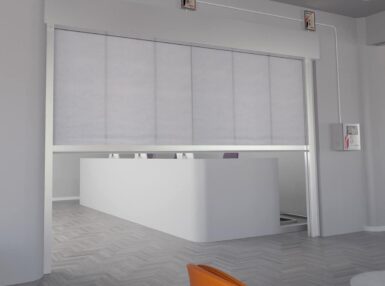
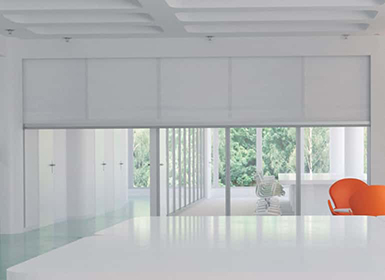
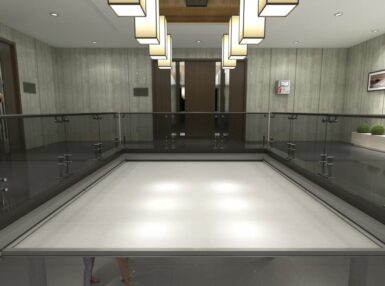
- Allows the creation of hidden divisions using a fire curtain system, splitting buildings, industrial warehouses, refrigerated chambers, etc. into fire sectors.
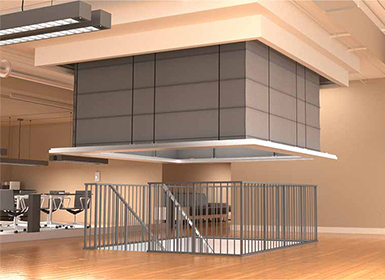
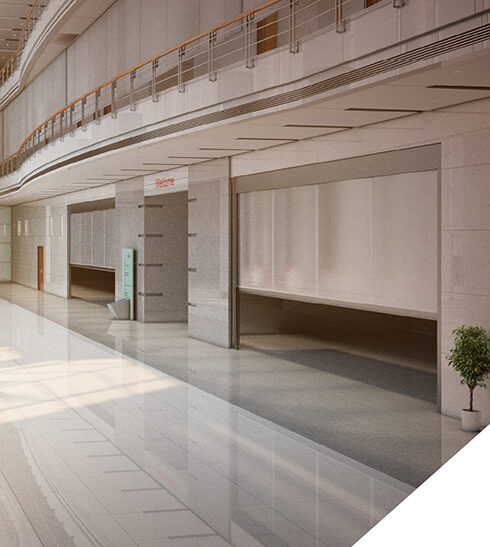
- This is an ideal solution for sectorisation in areas where there is a need for movement of machinery, people, vehicles, or conveyor belts, allowing spaces to be kept open.
 Safety And Guarantee
- Control of production in the factory.
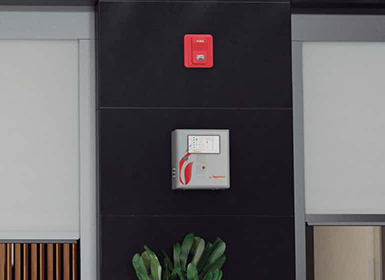
- Autonomous system with remote management and control of fires (depending on model).
- Automatic fire curtains with controlled lowering and FAIL SAFE emergency drop system integrated into the motor.
- Speed of lowering in accordance with ASB1 – ASB3.

Aesthetic
- Invisible system for the compartmentalisation of fire and smoke.
- Integration and consistency with architectural elements.
- Creation of sectors, after the activation of the system by the fire protection unit.
- Finished in choice of RAL colours.
 Resistance And Durability
- High temperature resistance (1000ºC) under regulation EN 1634-1.
- Over 1,000 operation cycles.
- Non-penetrable by smoke with pressure of 25 Pa (0.00 m3/h).

Functional
- Easy installation and maintenance.
- Pre-assembled systems.
- Control of system status, management of maintenance and system lifespan.
- UPS uninterruptible power supply with autonomy of up to 6 hours.
- Control of position and status of the barriers.
APPROVALS


EN 1634-1
Fire doors and barriers:
Defines the fire testing procedure of the systems to ensure they meet strict fire resistance standards.
EN 13501-2
Classification based on the behaviour of construction products and building elements against fire. Part 2: Classification based on data obtained from fire resistance tests excluding ventilation installations. This standard classifies systems based on their behaviour against fire, ensuring reliability in fire safety applications.
EN 15269-11
Extension of fire resistance results for fire curtains.
This standard outlines the extrapolation of fire curtains with dimensions greater than those tested, allowing for scalable fire protection solutions.
TECHNICAL EVALUATION REPORT ON SUITABILITY
This report specifies the final characteristics of the system in a single document, detailing the various tests carried out, installation placements, maximum dimensions, and the intended use of the system, ensuring compliance with all relevant fire safety standards.
Parts list
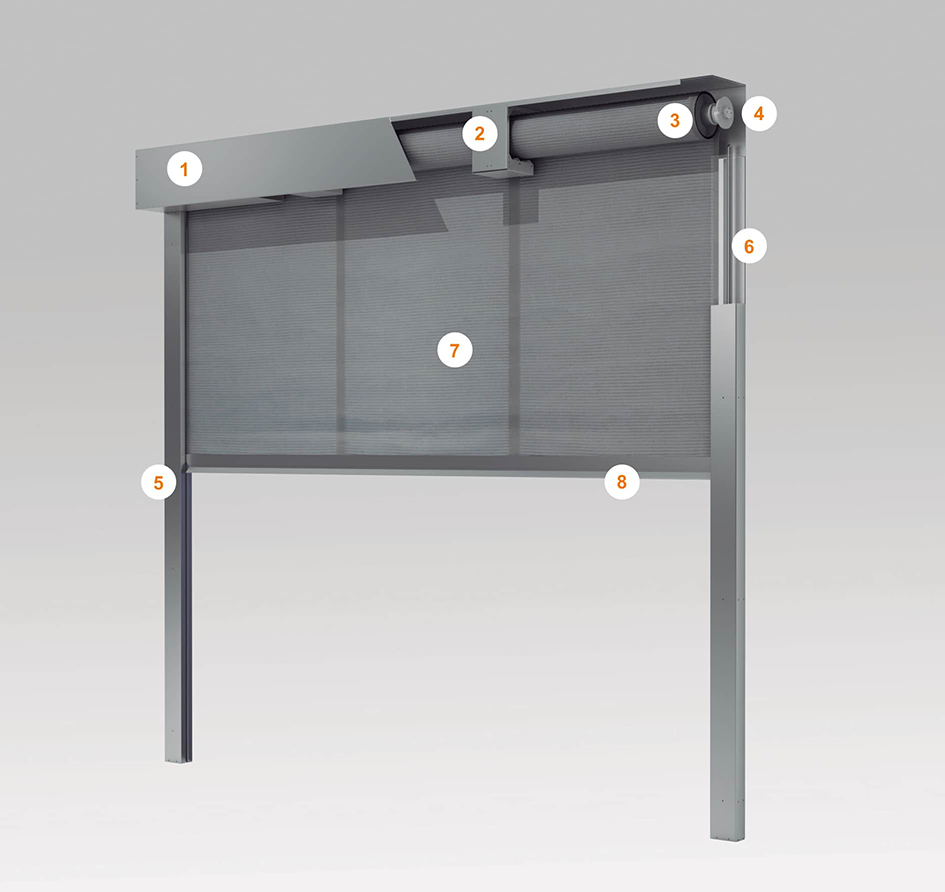
Parts list
- 1Housing – Made from galvanized sheet metal, tailored to the specific model.
- 2Removable supports – Designed to hold the roller and form the box (depending on the model). Openings are constructed with rounded edges to ensure safety and ease of installation.
- 3Roller – Equipped with an ogive to facilitate the smooth rolling of the textile.
- 4SMK motor – Features “TGFS” (Total Gravity Controlled Fail Safe Solution) technology, depending on the model, ensuring safe and efficient operation.
- 5Lateral guides – These guides feature a fabric-holding system running along the entire vertical side of the curtain.
- 6Textile holding system – Ensures the textile is securely held along the full vertical side for proper fire and smoke isolation.
- 7Technical fiberglass textile – Available in various finishes, chosen based on the model and classification of the system.
- 8Counterweight – Offered in various finishes and sizes for optimal adaptation to the box or suspended ceilings.