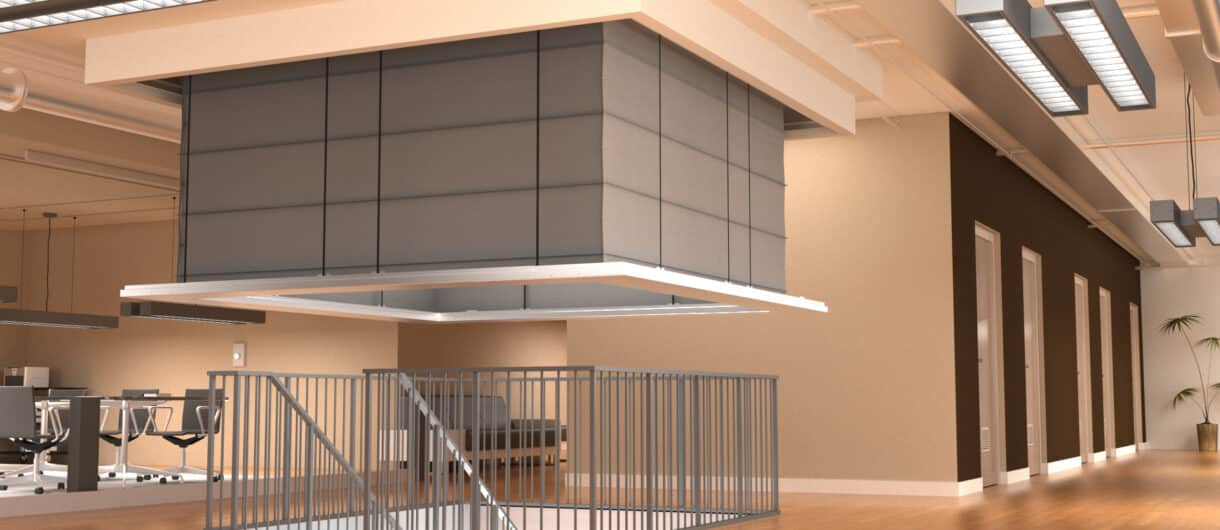
The fail-safe concept in fire curtains: when safety depends on more than just a battery
In recent years, the market for fire curtains and smoke control curtains has evolved considerably from a technical perspective. However, some confusion has also arisen regarding a fundamental concept in fire safety systems: fail-safe operation.
It is increasingly common to find solutions in which the lowering of the curtain in the event of a fire is achieved by incorporating auxiliary power supplies (UPS or batteries) into the control panels. Although this approach can improve the continuity of the power supply, it should not be confused with a truly fail-safe system.
And this difference is critical from a safety perspective.
What ‘Fail-Safe’ really means
A fail-safe system is one which, in the event of any type of failure or malfunction, automatically switches to a safe state. In the case of a fire curtain, the safe state is clear: the curtain must descend in a controlled manner to compartmentalise the fire.
Therefore, a truly fail-safe system must ensure closure in the following scenarios:
- Loss of power supply
- Control panel failure
- Motor controller failure
- Damage to the wiring
- Electronic failure
- Activation of system safeguards
In other words: the system must close by physical principle and safely, not because of the availability of power.
This is the classic principle of many industrial safety systems: when everything fails, the system is placed in a safe position by design.
A common misconception: confusing UPS with Fail Safe
Some manufacturers market systems incorporating UPS units or batteries in control panels as “Fail Safe” to ensure the motor lowers in the event of a mains power failure. Although this approach provides power redundancy, it does not eliminate the system’s critical weakness: total reliance on a single power source and the integrity of the wiring.
If any of these components are affected during a fire, the system may be unable to function and, in that case, the curtain would not descend.
This means that the system’s behaviour no longer depends on the Fail Safe design, but rather on all electrical components remaining operational during the fire.
The practical implications of this design
For a system relying on auxiliary power to operate reliably during a fire, additional conditions must be met which are often not clearly stated:
- Use of fire-resistant cabling
- Installation of the control panel in protected areas
- Location in fire-resistant plant rooms
- Additional protection for controllers and electronic devices
Otherwise, the system may lose its ability to close before the curtain is activated.
This aspect is particularly critical because the primary function of a fire barrier is to activate precisely when the fire is already affecting the building.
The risk of misinterpretation
When solutions based solely on backup power are presented as if they were fail-safe systems, there is a risk of conveying a misleading impression of safety to the market.
A safety system whose activation depends on the correct functioning of control elements, wiring and external power sources cannot be considered equivalent to a system designed to close by mechanical or gravitational means in the event of a failure.
From the perspective of fire safety engineering, this distinction is fundamental.
Actual safety vs perceived safety
Fire safety should not be based on optimistic assumptions about how equipment will perform during a fire, but on robust design principles that minimise points of failure.
In critical compartmentation systems, the design should answer a simple question:
What happens if all the electrical components stop working?
If the answer is that the curtain continues to close in a controlled manner, then we are dealing with a truly fail-safe system.
If the answer is that it depends on the electronics continuing to function, then we are talking about a system with a power backup, but not necessarily a fail-safe system.
In fire safety systems, words matter. Especially when terms such as ‘fail-safe’ are used, which imply a very specific behaviour of the system in the event of a failure.
The incorporation of UPS units or batteries may be an interesting technical improvement, but it does not replace the fail-safe operating principle.
In a real fire, the difference between these two concepts can be decisive in determining whether or not a compartmentalisation system fulfils its function.