

When we talk about fire protection, it is essential to understand the differences and similarities between fire doors and fire curtains. Both solutions are key to ensuring safety in buildings, but they have specific features and uses that make them unique. This article will provide you with a detailed overview of what they are, how they work, and the main differences between these two types of protective barriers.
What will you learn in this article?
- What is a fire door?
- Features of RF doors
- Types of fire doors
- What is a fire curtain?
- How fire doors and fire curtains are similar and different
- When we recommend fire curtains over fire-resistant doors
What is a fire door?
A fire door or fire-resistant door is an essential component of passive fire protection in any building. These doors are designed to contain fire and prevent it from spreading to other areas, thus facilitating evacuation and minimizing structural damage. They are made of fire-resistant materials such as treated wood, special glass, steel, and other metal alloys.
“A door is defined as a dividing element between two zones that allows the passage or circulation of objects through it.”
Features of RF doors
Among the most notable features of fire doors are the following:
Fire Resistance
Fire doors are designed to withstand fire for a specific period, sectorizing the space and preventing the spread of flames. They are generally classified according to their fire resistance capacity in minutes:
- RF 30 Doors: Resist for 30 minutes.
- RF 60 Doors: Resist for 60 minutes.
- RF 90 Doors: Resist for 90 minutes.
- RF 120 Doors: Resist for 120 minutes.
These classifications are essential to determine the appropriate type of door depending on the level of protection required in each area of the building.
Automatic Closure
A crucial feature of fire doors is their automatic closing mechanism. This system ensures that the door remains operational even after numerous openings and closings, which is vital during a fire.
Types of fire doors
Depending on their movement or construction, the following types are available:
Swing Fire Door
These doors typically consist of one or two leaves mounted on a perimeter frame with hinges. They can remain open using electromagnetic devices that are automatically activated in the event of a fire. Swing doors are considered “pass-through doors,” so they require durability tests to verify their resistance to openings and closings.

Durability classification:
- C0 No cycle classification
- C1 500
- C2 10,000
- C3 50,000
- C4 100,000
- C5 200,000
Sliding Fire Door
These doors are made of one or several leaves suspended at the top on a track for lateral movement. They can be automated using chain mechanisms or counterbalanced. They are considered mobile partitions.
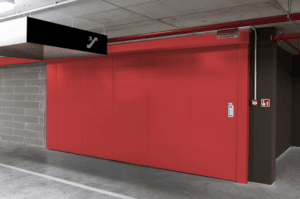
Guillotine Fire Door
These doors are made of one or several leaves guided by lateral mechanisms and held at the top, generally with an electromagnet. Their movement is vertical, with controlled descent via counterweights or mechanical elements for braking control. They can be automated with chain mechanisms or counterbalanced. Guillotine doors are also considered mobile partitions.

Roller Fire Door
These doors are made of horizontal slats that allow them to roll up around an axis, forming a spiral.
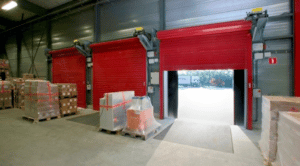
Roller doors can be considered industrial doors with fire resistance properties.
According to their fire resistance classification:
- For flames (integrity): E (time)
- Reduced radiation: EW (time)
- With thermal insulation: EI (time)
To delve deeper into this subject, we also have an article about fire resistance classifications.
What is a fire curtain?
The fire curtains are fire protection systems consisting of a retractable textile mechanism hidden inside a container box. When a fire is detected, the curtain automatically descends at a controlled speed, completely closing the opening from the ceiling to the floor. This ensures integrity, isolation, and low radiation, in addition to providing excellent smoke impermeability.
At Tecnitex, we specialize in fire protection systems, and our fire curtains offer efficient protection adaptable to any architectural space. Discover more about our solutions here.
How Fire Doors and Fire Curtains Are Similar and Different
RF Doors Vs Curtains: Advantages and Disadvantages
Let’s analyze the advantages and disadvantages of each system.
Advantages of fire doors
- High mechanical resistance.
- Structural durability over time.
- In some cases, they can be used to protect evacuation routes, integrating into them.
- Can remain open using retention devices (electromagnets) activated by fire signals.
- Dual function: security closure + protective closure.
Disadvantages of fire doors
- They are always visible, or their integration into the space is complicated.
- Very heavy systems, requiring reinforced structural support.
- Need for large lateral or upper space for the leaf housing.
- Size limitations.
Advantages of fire curtains
- Light and compact systems.
- Systems that integrate into architectural space (invisible).
- Can be extrapolated to larger dimensions.
- Possibility of polygonal layouts without using lateral guides (accordion/concertina).
- Configuration of closures in vertical and horizontal planes.
Disadvantages of fire curtains
- Due to their textile nature, they are not valid as security closures.
- More susceptible to mechanical wear.
- Limitations in solutions for evacuation routes.
- Not considered pass-through doors.
When we recommend fire curtains over fire-resistant doors
After the analysis above, we can conclude and recommend the use of fire curtains in scenarios where we encounter large dimensions to sectorize. However, Tecnitex recommends the logical use of this feature.
Large curtains reduce their durability, and are also harder to install and maintain.
Another advantage is the ease of integration of the systems in renovation projects, where we find limited space for placing elements.
Light and compact systems
They represent an innovative solution to the architectural concept of open space, allowing for larger and brighter environments without disrupting aesthetics.
Invisible systems
Raúl Alonso Sastre
CEO at Tecnitex Fire Systems