Fire safety in theatres
Theatres have a unique layout amongst public buildings. The combination of large audience capacity, multi-level spaces, complex evacuation routes and a stage area with a high functional load means that this type of building requires specific fire protection solutions. Fires such as those at the Globe Theatre in London in 1613, the Brooklyn Theatre in New York in 1876, the Theatre Royal in Exeter in 1887 and the Teatro Sannazaro in Naples in February 2026 highlight, in very different contexts, the need to control the spread of fire between the stage and the auditorium and to address evacuation requirements.
What will you learn in this article?
- Fire protection in theatres: risks and critical points
- Essential fire protection measures in theatres
- Renovation of historic theatres: how to compartmentalise without compromising the architecture
Fire safety in theatres: risks and critical points
Fire safety in a theatre must be approached from a holistic perspective of the building. These spaces combine areas open to the public with technical areas where electrical equipment, stage props, scenery, textiles, machinery, auxiliary installations and combustible materials may be concentrated.
This configuration requires an analysis not only of the possible source of the fire, but also of its rate of spread, the generation of smoke and the impact this may have on evacuation routes.
Risks associated with the stage area and technical equipment
The stage area is one of the most sensitive spaces within a theatre. Its large interior volume, the presence of overhead elements and the concentration of lighting, sound, stage machinery, stage equipment and electrical systems mean that it must be considered a critical zone within the fire protection analysis.
During a performance, sets, curtains, textiles, temporary cabling, high-temperature spotlights and auxiliary materials may all be present. If these elements are not properly controlled, they can contribute to the outbreak of a fire or accelerate its spread during the early stages of the incident.
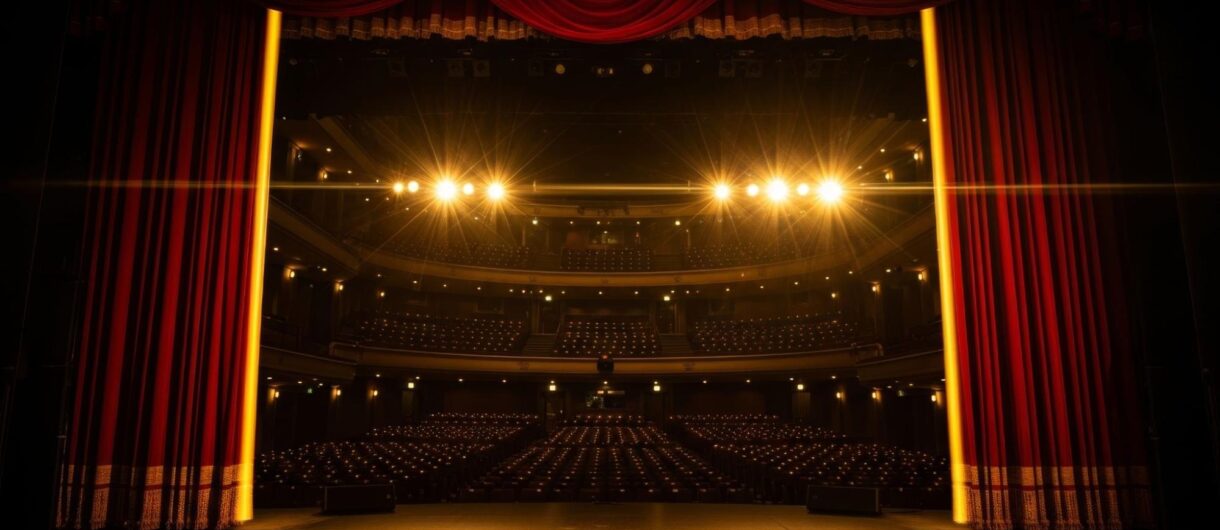
Connection between the stage and the auditorium: the stage opening and the proscenium
One of the critical aspects of a theatre is the connection between the stage area and the auditorium. This connection occurs around the stage opening, where the proscenium is located: the front part of the stage closest to the area occupied by the audience.
Combustible materials, sets and stage elements
Theatres incorporate materials associated with stage activities that may exhibit poor fire behaviour if they do not have the appropriate classification or treatment. Curtains, drapes, coverings, sets, lightweight panels, wood, foam or fabrics can increase the fire load of the space.
The risk increases when these materials are stored near electrical equipment, lighting, technical areas or secondary spaces without sufficient compartmentalisation, such as the sides of the stage, storage rooms, technical dressing rooms or areas under the stage.
Evacuation and smoke spread
One of the main challenges in a theatre is ensuring the safe evacuation of a large number of people. The presence of stalls, amphitheatres, boxes, staircases, corridors and different levels can make escape routes more complex than in other public buildings.
In the event of a fire, smoke can quickly impair visibility, make it difficult for occupants to find their way and affect evacuation conditions. Therefore, in addition to limiting the spread of flames, it is necessary to plan how the smoke generated will be contained, channelled or evacuated.
Essential fire protection measures in theatres
The fire protection strategy in a theatre must combine active and passive measures: detection, alarm, evacuation, smoke control, fire resistance of building elements and compartmentalisation of the building.
Fire compartmentalisation in theatres using textile solutions
Fire compartmentalisation is a passive fire protection measure that involves dividing the building into fire compartments, so that each one can maintain its structural integrity against the effects of fire for a specified period of time. Its main function is to limit the spread of fire beyond the area of origin and to protect both evacuation routes and adjacent areas.
In theatres, auditoriums and performance halls, compartmentalisation cannot always be achieved using fixed structural elements. Many spaces need to remain open during the building’s normal use so as not to interfere with stage activity, visibility, circulation or the architectural layout.
Advantages of Textile Curtains in Theaters
Textile curtains allow for the compartmentalization of large openings without the introduction of permanent structural elements. In a theater, this is especially relevant, as the connection between the stage and auditorium must remain unobstructed during normal use of the building.
Their main advantage is their retractable nature: they remain hidden in their housing during daily activity and are deployed only when they receive a signal from the fire protection system. This allows for the preservation of stage functionality, visibility from the auditorium, and the architectural character of the space.
They also offer easier integration in projects with complex geometries or structural limitations. As they are lightweight and compact systems, they can be incorporated into both new construction and renovations, reducing the need for fixed elements that occupy usable space or permanently alter the building.
Furthermore, they allow for the closure of openings defined in the design and contribute to the overall compartmentalization of the theater, limiting the spread of fire between areas with different uses, risks, or occupancies. In combination with smoke control barriers, they help to configure a more complete fire protection strategy, aimed not only at containing the fire, but also at improving evacuation conditions.
Rehabilitation of Historic Theaters: How to Partition Without Interfering with the Architecture
The rehabilitation of historic theaters introduces constraints that are not usually as pronounced in new construction. In these types of buildings, the intervention must be carried out on a pre-existing architecture whose configuration does not meet current protection criteria, but which at the same time holds significant spatial, structural, and, in many cases, heritage value.
This directly affects how the partitioning of the space is approached. The geometry of the proscenium arch, the proportions of the auditorium, the presence of ornamentation, the original finishes, and the very configuration of the stage area can limit both the available space and the possibilities for intervention on ceilings, sides, supports, or structural junctions. In addition, there are often restrictions stemming from the building’s conservation, which require minimizing the visual impact, avoiding permanent alterations, and ensuring the solution complies with heritage protection criteria.
It is also necessary to analyze the existing support structure, the geometric tolerances of the opening, the load-bearing capacity of the elements where the system will be integrated, and the relationship between the new solution and the theater’s original components. In renovation, it is not enough to simply verify a performance; it is also necessary to verify how it is implemented, what degree of transformation it requires, and how it affects the overall architectural structure.
Therefore, compartmentalizing a historic theater is not just about incorporating a protection system, but about adapting its implementation to a building with very specific pre-existing conditions. The quality of the solution depends on its ability to meet the project’s requirements without compromising the spatial perception, the building’s structural logic, or the theater’s normal operation.
Do you need to incorporate compartmentalization solutions in your next project?
At Tecnitex, we design and implement textile systems, from the concept phase to commissioning and subsequent maintenance, ensuring that each solution is integrated effectively and in accordance with current regulations. Contact us to assess your project’s needs.