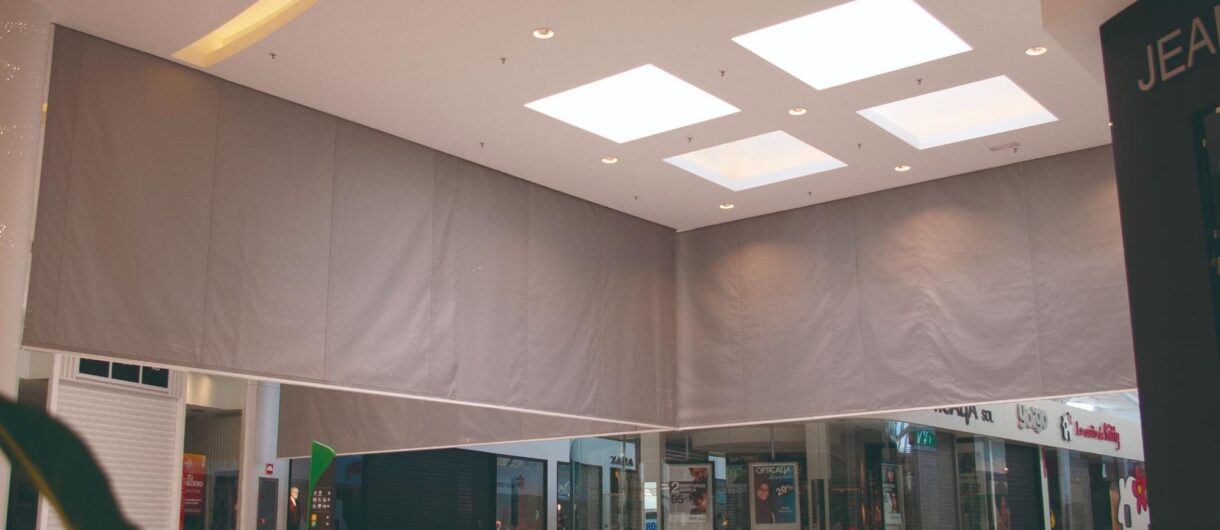
Fire curtains vs smoke curtains: what are the differences?
Within a comprehensive fire safety strategy, passive fire protection plays a fundamental role in containing the effects of fire and smoke on the building’s structure, its occupants, and evacuation routes. Unlike active systems, these solutions do not act directly on the source of the fire, but they are decisive in limiting its spread.
Among the various available measures, compartmentation is an effective method to prevent fire propagation between functionally independent areas. Its correct implementation directly influences the behavior of fire and hot gases inside the building and often requires the installation of textile systems such as fire curtains and smoke control curtains.
What will you learn in this article?
- What is fire compartmentation?
- Advantages over traditional solutions
- Do you need to include fire or smoke compartmentation in your next project?
What is fire compartmentation?
Compartmentation is a passive fire protection measure that divides a building into fire-resistant sectors capable of maintaining integrity under fire exposure for a specified duration. This division aims to limit the spread of fire beyond its origin, protect escape routes, and reduce heat transfer to other structural components, minimizing the risk of collapse.
Each sector must be defined by enclosures that meet regulatory requirements, which vary depending on the Building Code of each country. Classification depends on the intended use, occupancy, and associated risks. In open-plan or shared spaces, automated textile solutions may be needed to ensure fire separation without compromising day-to-day functionality.
Additionally, within the overall smoke control strategy, it is essential to distinguish between two complementary concepts: smoke reservoirs and smoke channelling. Smoke reservoirs are used to contain hot gases using curtain barriers, while channelling barriers direct smoke toward extraction points, keeping lower areas free of contamination and ensuring safe evacuation.
Fire curtains
Fire curtains act as mobile barriers that define fire sectors. They are classified according to their fire resistance:
- E: resistance to flames and gases penetration.
- EW: prevents flame and gas passage while limiting thermal radiation beyond 1 meter from the curtain.
- EI: prevents flame and heat passage, may not require irrigation.
From a regulatory standpoint, fire curtains must comply with EN 1634-1 for resistance testing, EN 13501-2 for classification, and EN 15269-11 when extended application is needed for dimensions or configurations beyond tested limits.
Smoke control barriers
Smoke barriers are textile systems designed to create smoke reservoirs or guide smoke to adjacent spaces. Their primary function is to prevent smoke from descending into evacuation routes, maintaining visibility and safe conditions during an emergency. They also help maintain a stable smoke layer temperature, preventing flashover and preserving stratification, which is critical for evacuation safety.
These barriers can be fixed or automatic, and their deployment height depends on the design of the smoke layer, space type, and predicted thermal behavior. In all cases, they must ensure thermal stability, mechanical strength, and controlled smoke permeability as per EN 12101-1.
Their classification is denoted by the codes D+t and DH+t, indicating test temperature and resistance time to smoke leakage:
- D+t: Performance at 600 °C, with time ratings D30, D60, D90, D120. If the time exceeds 120 minutes, the “t” is replaced with “A”.
- DH+t: performance at 1,000 °C, same time ratings (DH30, DH60, etc.). If it exceeds D120, it’s classified as DHA (e.g. DHA-150).
Advantages over traditional solutions
Unlike conventional systems —such as fire walls or fire-rated doors—, Tecnitex textile solutions enable efficient compartmentation without compromising design or space usage. This is especially relevant in hotels, airports, shopping centers, or heritage buildings, where it is essential to preserve aesthetics, flow, and structural lightness. Key advantages include:
- Discreet architectural integration: remain hidden in normal conditions and only deploy during emergencies, preserving the visual continuity of open or double-height spaces.
- Lightweight: made from technical fabrics like coated fiberglass, they do not impose heavy loads on the structure—ideal for renovations or buildings with weight limitations.
- No loss of usable space: compartment areas without occupying square meters, avoiding permanent structural elements like walls.
- Versatility in new or existing buildings: adaptable to various spatial configurations without major design or functional constraints.
From a regulatory perspective, Tecnitex solutions are tested and certified under applicable European standards:
- Fire curtains comply with UNE EN 1634-1 in their various fire resistance classifications (E, EW, EI).
- Smoke control barriers are certified to UNE EN 12101-1 and rated A2-s1, d0 according to UNE EN 13501-1.
Additionally, systems are tested for over 1,000 operating cycles and guarantee smoke tightness up to 25 Pa, with leakage rates under 0.003 m³/h, making them technically reliable and compliant with demanding evacuation scenarios.
Do you need to include fire or smoke compartmentation in your next project?
At Tecnitex, we design and implement textile systems from concept to commissioning and maintenance, ensuring each solution is effectively integrated and fully compliant with regulations. Contact us to evaluate your project requirements.