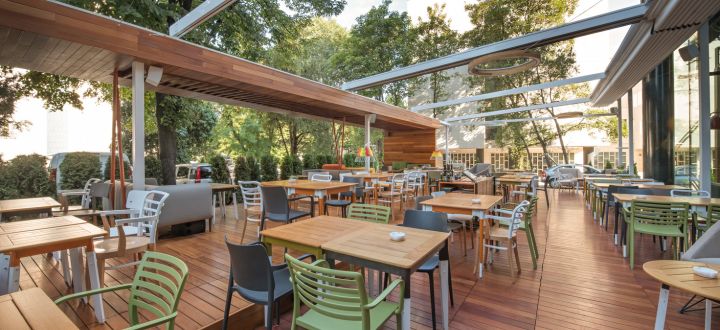
Fire safety in outdoor restaurants
Outdoor restaurants present specific risks that must be analysed from the very first stages of spatial design: open kitchens, heaters, embers, electrical installations, awnings, lightweight enclosures and combustible furniture.
In covered terraces, inner courtyards, rooftops or dining areas linked to hotels and shopping centres, these elements can influence the spread of fire and smoke. For this reason, it is important to study the layout of the space, the materials used, the proximity between heat sources and combustible elements, and the connection with other areas of the building.
What will you learn in this article?
- Why fire safety in outdoor restaurants requires a specific approach
- Fire regulations in restaurants: CTE, RIPCI and local ordinances
- Design criteria to reduce fire risk in outdoor restaurants
- Fire protection measures in outdoor restaurants
Why fire safety in outdoor restaurants requires a specific approach
An outdoor restaurant does not always behave like an open space. The presence of roofs, side enclosures, pergolas, awnings or inner courtyards can alter ventilation, heat build-up and smoke spread.
In addition, these spaces often combine seating areas, auxiliary kitchens, electrical installations, outdoor heating and decorative elements. That is why the analysis must begin with the real configuration of the restaurant: whether it is completely open, partially enclosed, connected to an indoor dining room or part of a building with other uses, such as hotels, shopping centres or leisure facilities.
Outdoor restaurants, covered terraces and semi-open spaces
A street-level open terrace does not present the same conditions as a covered inner courtyard or a rooftop with an outdoor kitchen. In semi-open spaces, smoke can remain trapped beneath a roof or move into indoor areas through openings, access points or circulation routes.
Clear height, wind direction, type of enclosure, occupancy density and the materials used also have an impact. These factors determine the fire protection strategy and the need to incorporate compartmentation or smoke control measures.
Main ignition sources in outdoor hospitality areas
The most common ignition sources are found in cooking equipment, embers, griddles, fryers, ovens, heaters, decorative lighting and auxiliary electrical installations.
The risk increases when these elements are located close to awnings, parasols, textiles, artificial vegetation, decking, lightweight cladding or combustible furniture. Storage areas, service routes and temporary equipment must also be reviewed, as with daily use they may end up functioning as a permanent part of the restaurant.
Fire regulations in restaurants: CTE, RIPCI and local ordinances
In Spain, fire regulations in restaurants are mainly analysed through two regulatory frameworks: the CTE DB-SI and the RIPCI. The CTE DB-SI establishes fire safety requirements in buildings, covering aspects such as fire spread, evacuation, fire resistance and protection systems.
The RIPCI regulates the design, installation, maintenance and inspection conditions for active fire protection equipment and systems. In a restaurant, this affects elements such as extinguishers, detection, alarms and extinguishing systems.
Why local ordinances may change terrace requirements
Local ordinances do not usually define the restaurant’s fire protection strategy. That part depends on the technical project and the applicable regulations, such as the CTE DB-SI and the RIPCI.
What they do regulate is what can be installed on the terrace and under what conditions: enclosures, awnings, parasols, heaters, decking, planters, dividing elements or furniture. For example, terrace authorisations in Madrid include elements such as tables, chairs, parasols, movable dividers, auxiliary elements and greenery.
This directly affects the risk analysis. A side enclosure, heater or awning is not merely a comfort element; it can also modify ventilation, increase the combustible load or bring heat sources closer to sensitive materials.
That is why, before designing a covered or semi-open terrace, it is advisable to review the local ordinance and check how these elements fit into the overall fire safety strategy.
Design criteria to reduce fire risk in outdoor restaurants
Prevention does not depend solely on reviewing materials or placing equipment away from a heat source. In outdoor restaurants, many architectural decisions influence fire behaviour: the position of the kitchen, the type of enclosure, ventilation, service routes and the way installations and furniture are integrated.
For this reason, a covered terrace, inner courtyard or rooftop must be studied as a technical space, not only as a hospitality area. The layout, materials and installations must respond to the restaurant’s daily operation and also to a potential fire scenario.
Layout of hot zones, seating areas and service routes
Not all areas of a terrace have the same level of risk. Cooking areas, auxiliary bars, storage areas, waiter routes and customer seating areas must be organised to avoid interference.
A poorly located outdoor kitchen can bring heat, grease or electrical equipment close to high-occupancy areas. Likewise, a congested service route can make a rapid response more difficult in the event of an incipient fire.
Enclosures, roofs and ventilation
A side enclosure, pergola or lightweight roof can completely change smoke behaviour. A space that appeared open may, in practice, behave like a semi-indoor area.
For this reason, before enclosing a terrace, it is advisable to study how air renewal will take place, where smoke would move and how the space relates to doors, façade openings or common areas of the building.
Installations integrated from the design phase
In many outdoor restaurants, lighting, heaters, sound systems, display cases or electrical connection points are added progressively. This layered growth can result in installations that are difficult to control.
Integrating these needs from the design phase makes it possible to organise cable routes, auxiliary panels, electrical protection systems and maintenance points. It also reduces the use of temporary solutions that end up remaining in place throughout the season.
Fire protection measures in outdoor restaurants
The fire protection strategy in outdoor restaurants must combine active and passive protection measures. Active measures — such as detection, alarms, extinguishing systems or intervention systems — help detect and control the fire. Passive measures, on the other hand, act on the building itself: they limit the spread of fire and smoke, protect escape routes and separate risk areas.
Fire compartmentation in outdoor restaurants connected to the building
Fire compartmentation makes it possible to divide the building into separate areas in order to limit the spread of smoke and flames. Different systems can be used for this purpose, such as walls, fire doors or textile fire curtains.
Advantages of fire curtains and smoke control barriers
Fire curtains and smoke control barriers are particularly suitable solutions for outdoor restaurants connected to the building because they allow passive protection to be incorporated without altering the daily use of the space.
One of their main advantages is that they deploy only in the event of a fire. During normal restaurant operation, they remain retracted, so they do not interrupt circulation, visually divide the terrace or compromise the aesthetics of the project. This is especially useful in covered terraces, inner courtyards, rooftops, hotels or gastronomic spaces where visual continuity is part of the architectural design.
They can also be integrated into suspended ceilings or existing construction elements, remaining hidden until activation. In this way, they make it possible to compartmentalise or control smoke without resorting to fixed walls, permanent doors or other elements that could reduce the feeling of openness in the restaurant.
Another important advantage is their lightness. As textile systems, they do not add a significant structural load, which facilitates installation both in new-build projects and in renovation or adaptation projects for existing terraces. This is particularly relevant in spaces where the structure, roof or slab has load limitations.
They also allow compartmentation without loss of usable floor area. In restaurants, every square metre has a clearly defined use: tables, circulation areas, auxiliary bars, access points, staff movement or connection with the indoor dining room. Fire curtains and smoke barriers make it possible to maintain this functionality during normal use of the space and act only when an emergency occurs.
Do you need to integrate compartmentation or smoke control solutions into your next project?
At Tecnitex, we design and implement textile systems from the concept phase through to commissioning and subsequent maintenance, ensuring that each solution is integrated effectively and in compliance with current regulations. Contact us to assess the needs of your project.