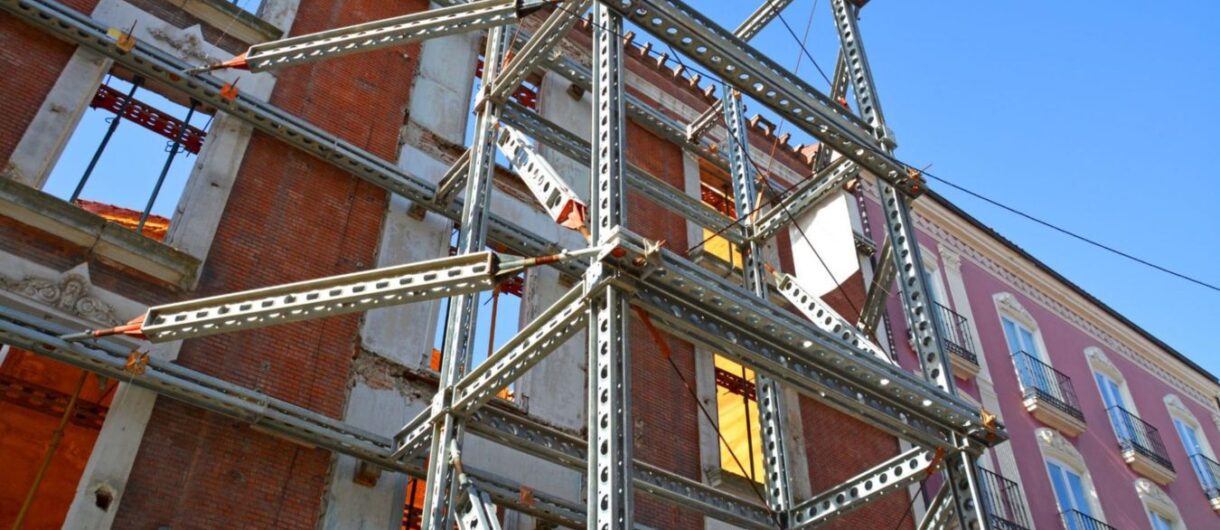
Fire protection in temporarily closed buildings or buildings under renovation
Fire protection in temporarily closed buildings or buildings under renovation must be assessed according to the actual condition of the property, its intended use, the existing fire load and the maintenance status of its fire protection systems. Even if the building has no ordinary occupancy, it may still have systems in service, active technical areas, temporary works or compartmentation elements affected by the renovation.
This approach does not refer to the protection of abandoned buildings, but to properties that are going to be reoccupied, renovated, rented, sold or brought back into service. In these cases, the objective is to verify whether the building maintains the expected performance in terms of internal fire spread, compartmentation, smoke control, stability of fire-resistant structural elements and operational availability of fire protection systems.
This review must be carried out taking as a reference the applicable requirements of the CTE DB-SI and the RIPCI, especially when the temporary closure or renovation may affect compartmentation, evacuation routes, smoke control or the operation of fire protection systems.
What will you learn in this article?
- Why a temporarily closed building still presents a fire risk
- Initial fire safety assessment during closure or renovation
- Fire protection measures in temporarily closed buildings or buildings under renovation
- Specific aspects of fire protection in refurbished buildings
Why a temporarily closed building still presents a fire risk
In a temporarily closed building or a building under renovation, the fire risk does not disappear: it changes according to the actual condition of the property. During this phase, operational areas, areas under intervention, temporary installations and construction elements that have not yet recovered their final performance may coexist.
Construction phases with incomplete or modified protection
During renovation, the building may be temporarily divided into areas with different levels of intervention: completed areas, areas under construction, spaces pending work and temporary routes for circulation or work.
This point is particularly relevant because fire safety should not be assessed only in the final state of the project, but also during the intermediate execution phases. At each stage, it is advisable to verify that the existing conditions do not create unintended connections between fire compartments or increase the risk of fire or smoke spread.
Construction works that generate ignition sources
Works may include activities with a specific fire risk, such as cutting, welding, grinding, electrical work, heat application or the use of portable machinery. These activities must be assessed in relation to the nearby fire load, the ventilation of the space and the availability of detection and extinguishing means.
Temporary storage and materials not foreseen in the original use
During closure or renovation, materials that were not part of the building’s usual use may appear: packaging, pallets, insulation, removed furniture, protective plastics, wiring or construction waste.
The risk does not depend only on the amount of material, but also on its location. Temporary storage near service shafts, installation routes, technical rooms, vertical openings or compartmentation elements can favour the spread of fire and smoke.
Initial fire safety assessment during closure or renovation
During renovation, the building must be read as a temporary configuration, not as the original building or as the completed building. This is especially important when the works are carried out in phases and operational areas, areas under intervention and spaces pending adaptation coexist.
From a fire protection perspective, the review must focus on three aspects: whether fire compartments remain defined, whether compartmentation boundaries maintain continuity and whether smoke can spread through openings, atriums, service shafts, suspended ceilings or large open spaces.
In this type of intervention, a temporary opening, an unresolved service penetration or a temporarily removed barrier can modify the building’s behaviour in the event of fire. For this reason, fire protection must also be analysed during the construction phase, not only in the final designed solution.
Fire protection measures in temporarily closed buildings or buildings under renovation
Fire protection measures in temporarily closed buildings or buildings under renovation must be defined according to the actual risk of the property and the condition of its existing systems. Active and passive protection, maintenance of fire protection systems, access control, fire load management and emergency service intervention conditions must all be considered.
However, in buildings with suspended activity or undergoing renovation, fire compartmentation plays a particularly important role. If a fire occurs and there is no ordinary occupancy, the building’s ability to limit the spread of fire and smoke between compartments may be decisive in reducing damage, preventing adjacent areas from being affected and facilitating intervention.
Compartmentation against fire spread
Fire compartmentation consists of dividing a building into independent fire compartments, delimited by elements with a specific fire resistance rating. Its objective is to prevent fire, smoke and temperature from spreading freely from the affected area to other spaces within the property.
Fire curtains and fixed smoke control barriers
Fixed fire curtains can be used as a permanent textile solution at points where it is necessary to maintain a fire-resistant separation without resorting to conventional construction elements. Their function is to contribute to the compartmentation of the building, limiting the spread of fire between connected areas, always in accordance with the required classification and the installation conditions of the project.
Fixed smoke control barriers, meanwhile, can act as elements for delimiting or channelling smoke. In the first case, they allow gases to be contained within a specific smoke reservoir; in the second, they help direct them towards the planned evacuation or extraction areas. This type of solution is particularly useful in logistics warehouses, large storage facilities, car parks, atriums or large-volume spaces.
Specific aspects of fire protection in refurbished buildings
In refurbished buildings, fire protection must adapt to the limitations of the existing property and the new intended use. Unlike a new-build project, the intervention may be conditioned by structural elements, clear heights, existing openings, evacuation routes, service shafts, previous installations or architectural conservation criteria.
In these cases, compartmentation plays a relevant role because it allows safety requirements to be made compatible with the actual configuration of the building. It is not always feasible to incorporate conventional construction solutions without affecting the layout, aesthetics or functionality of the space. For this reason, textile solutions can be an effective alternative in areas where compartmentation is required without introducing high-impact permanent elements.
Do you need to integrate compartmentation or smoke control solutions into your next project?
At Tecnitex, we design and implement textile systems from the concept phase through to commissioning and subsequent maintenance, ensuring that each solution is integrated effectively and in compliance with current regulations. Contact us to assess the needs of your project.