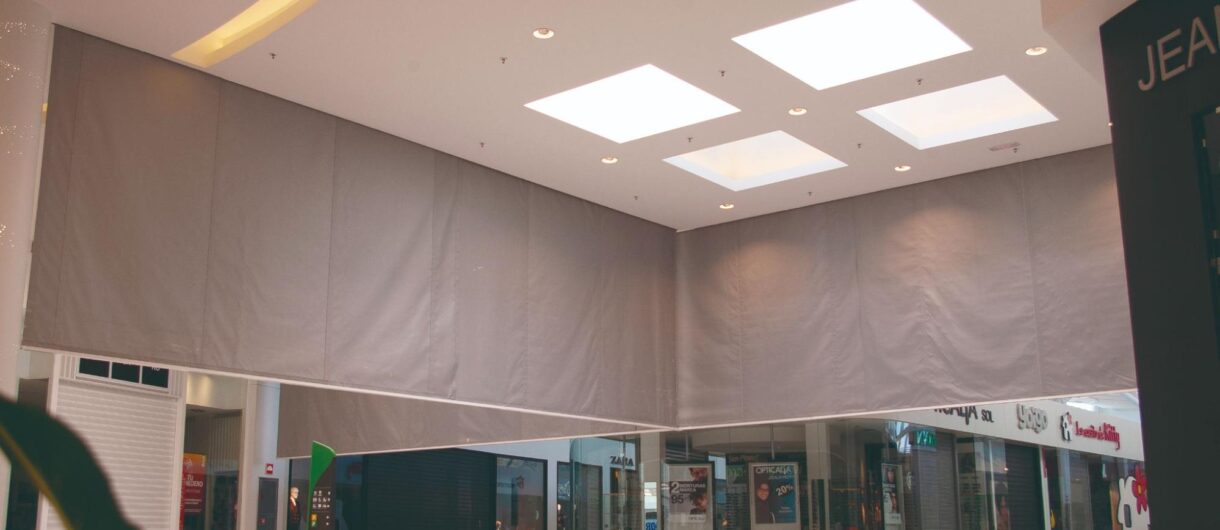
Importance of labels on fire curtains and smoke control barriers
In passive fire protection systems, a visible label is not an accessory element. In fire curtains and smoke control barriers, system identification makes it possible to verify which product has been installed, with which performance characteristics, under which technical documentation, and for which intended use.
When a label is hidden, painted over, damaged, or inaccessible, inspection becomes more complex. And in a system designed to compartmentalise fire or channel smoke, this loss of traceability can affect safety, maintenance, and the documentary justification of the project.
What will you learn in this article?
Why label visibility is critical in fire protection
What information a label must retain
CE marking and regulations
Risks of hiding, painting over, or covering labels during installation or refurbishment
Best practices for keeping labels visible
Why label visibility is critical in fire protection
Textile systems are often integrated into housings, suspended ceilings, side guides, or concealed architectural solutions. Precisely for this reason, label visibility is key: it helps identify the system without unnecessary dismantling and allows the installed product to be linked to its documentation.
What information should a label include on fire curtains and smoke control barriers?
The label must allow the product to be clearly identified and linked to its technical data sheet, test documentation, and declared performance. To achieve this, it should include a series of minimum data points that facilitate system traceability.
Identification of the manufacturer, model, and installed system
The first level of information is the identification of the manufacturer and the model. In fire curtains, this helps distinguish between systems with different performance classifications, such as integrity E, reduced radiation EW, or thermal insulation EI.
Declared performance, classification, and intended use
A fire curtain does not perform the same function as a smoke barrier. The former is designed for fire compartmentation and to limit the spread of flames and temperature. The latter operates within a smoke control strategy, channelling or containing hot gases to support evacuation and smoke extraction.
CE marking and regulations: implications for system identification
CE marking indicates that a product has been assessed in accordance with the applicable European requirements and that its performance has been declared by the manufacturer within the relevant framework. In construction products, this marking allows the installed system to be linked to its declaration of performance, technical data sheet, and the intended use for which it has been assessed.
According to the European Construction Products Regulation, the CE marking must be affixed to the product in a visible, legible, and indelible manner, or on a label attached to it. When this is not possible due to the nature of the product, it may be included on the packaging or in the accompanying documents.
Risks of hiding, painting over, or covering labels during installation or refurbishment
On site, labels may become hidden by architectural finishes, paint, poorly positioned access panels, or subsequent modifications. This issue usually appears later: during an inspection, a maintenance review, or a refurbishment.
Suspended Ceilings, Paint, and Finishes That Compromise Identification
Fire curtains and smoke barriers are often installed discreetly so as not to interfere with the building’s design. This architectural integration is an advantage, but it must be carried out without compromising visual access to the label.
Impact on inspections, maintenance, and component replacement
An illegible label may require the review of drawings, certificates, site photographs, or supply documentation. This increases time, costs, and the risk of error. In preventive maintenance, it also makes it more difficult to verify whether the system being inspected matches the documented system.
Best practices for keeping labels visible
The solution is not just to attach a label, but to protect its legibility, accessibility, and traceability throughout the entire service life of the system.
Check the label during installation: before closing suspended ceilings, housings, or architectural trims, it should be verified that the label remains visible or accessible for future inspections.
Prevent it from being covered by subsequent finishes: paint, adhesives, sealants, cladding, or decorative elements may prevent the label from being read and make system identification more difficult.
Record its location at project handover: it is advisable to indicate where each label is located in the final documentation dossier, especially when the system is integrated into concealed solutions.
Include photographs in the documentation dossier: photographic records help link each installed system to its technical data sheet, certificates, manuals, and maintenance documentation.
Check its condition during each maintenance operation: the label must remain legible and allow the system to be identified without ambiguity throughout its service life.
Replace or document any damaged label: if a label is damaged, lost, or no longer legible, its replacement must be managed or documentary evidence must be recorded in order to maintain system traceability.
Do you need to incorporate fire compartmentation or smoke control solutions into your next project?
At Tecnitex, we design and implement textile systems from the concept phase through to commissioning and subsequent maintenance, ensuring that each solution is effectively integrated and compliant with current regulations. Contact us to assess the requirements of your project.