What is a SHEV system and how does it work?
Smoke and Heat Exhaust Ventilation Systems (SHEVS) play an essential role in fire protection, as they make it possible to manage one of the most dangerous factors during a fire: smoke. In a fire, it is not only the flames that must be controlled; it is also essential to limit the accumulation and spread of hot gases, improve visibility along escape routes, and facilitate the intervention of firefighting teams. In this context, the proper design of a SHEVS is crucial to ensuring people’s safety, protecting the building structure, and reducing material damage.
What will you learn in this article?
- Smoke as a risk factor in a fire
- The importance of thermal gradient and smoke compartmentation
- What a SHEVS is
- How curtains interact with SHEVS
Smoke as a risk factor in a fire
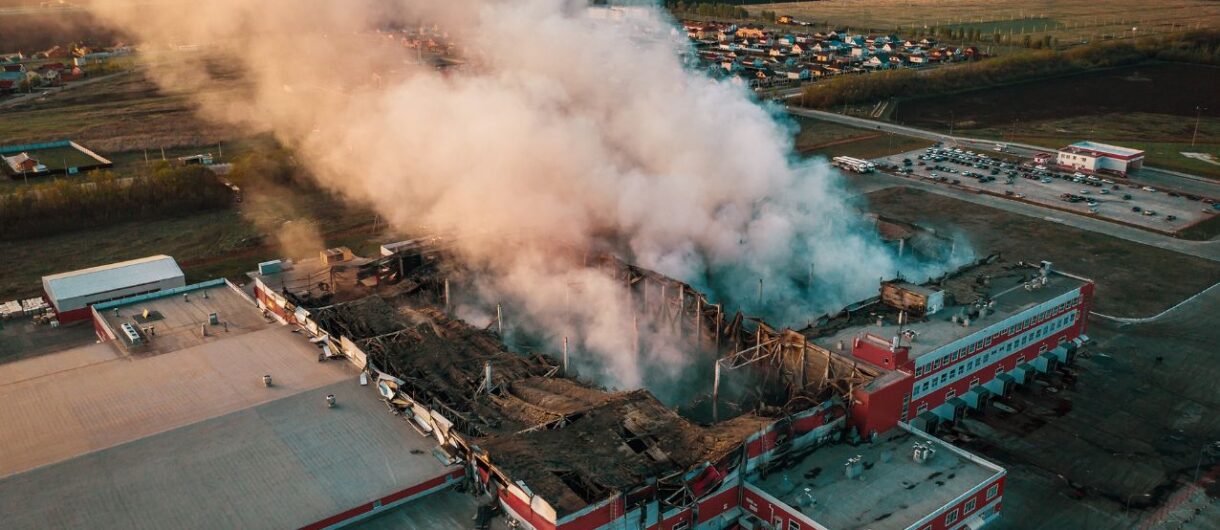
Smoke is one of the main risk factors in a fire. In fact, according to a Tecnifuego report, between November 2024 and February 2025, 7 out of 10 fatalities in fires and explosions were caused by smoke inhalation, which highlights the need to design effective smoke control, containment, and evacuation strategies.
In addition to its toxicity, smoke drastically reduces visibility, rapidly invades escape routes, and hinders both the safe evacuation of occupants and the intervention of firefighting teams. Added to this is the accumulation of hot gases, which can compromise the stability of the structure and promote the spread of the fire to other areas of the building. For this reason, smoke control must be considered a priority within any fire protection strategy.
The importance of thermal gradient and smoke compartmentation
During a fire, smoke behaviour is neither uniform nor stable. The temperature difference between the air layers and the gases generated by combustion causes a thermal gradient that affects its movement, accumulation, and distribution within the space. This phenomenon may favour smoke stratification in the upper layers, but it may also generate unwanted displacement that alters its path and complicates its control.
From the perspective of fire protection design, understanding this behaviour is essential. Smoke evacuation does not depend solely on the existence of vents or ventilators, but on the system’s ability to keep the smoke contained, channelled, and properly directed towards the extraction points. When smoke spreads uncontrollably across the entire available surface, it loses useful layer thickness, invades unintended areas, and reduces the overall effectiveness of the system.
This is where smoke compartmentation takes on a decisive role. Compartmentation using smoke barriers or smoke curtains makes it possible to limit the horizontal spread of hot gases, create controlled smoke reservoirs, and improve the performance of evacuation systems. Instead of allowing smoke to spread freely throughout the entire space, it is forced to concentrate within a defined volume, thereby facilitating its extraction and reducing the risk of spreading to adjacent compartments.
Therefore, controlling the thermal gradient and ensuring proper compartmentation not only improve the efficiency of the SHEVS, but also increase the safety of occupants, emergency response teams, and assets. In large-volume projects such as logistics centres, commercial spaces, or public buildings, this approach is key to ensuring a truly effective smoke control strategy.
What a SHEVS is
A Smoke and Heat Exhaust Ventilation System (SHEVS) is a fire protection installation designed to control the behaviour of smoke and hot gases generated during a fire. Its design responds to the need to manage one of the most critical effects of a fire, preventing smoke from spreading uncontrollably throughout the building.
This is a particularly relevant system in large-volume enclosures, public buildings, logistics environments, and industrial facilities, where smoke control directly affects evacuation safety and the operational effectiveness of the emergency response.
Objectives and functions
The purpose of a SHEVS is to act on smoke and heat in order to maintain safer conditions during the development of a fire. To achieve this, it acts on the accumulation, containment, and evacuation of combustion gases, helping to protect escape routes and improve operational response within the building.
Its main functions include smoke evacuation, reducing the temperature inside the enclosure, limiting spread to other areas, and improving access conditions for firefighting teams. In addition, it helps reduce the impact of the fire on the structure and on the assets contained within the installation.
What a SHEVS consists of
A SHEVS is made up of openings intended for smoke and heat control, commonly known as smoke and heat exhaust ventilators or ventilators, which may be used for exhaust or air inlet purposes and are usually installed on the roof. Their operation must be considered jointly and in a coordinated manner, since while some promote the controlled evacuation of smoke and hot gases accumulated in the upper part of the enclosure, others allow the entry of replacement air required to balance pressure and ensure the effectiveness of the system.
How it works in the event of a fire
When a fire starts, smoke and hot gases rise and accumulate in the upper part of the space. The SHEVS is designed to manage this accumulation, promoting its evacuation to the outside and preventing it from descending rapidly into occupiable areas or invading escape routes.
For this to happen effectively, the system must have been previously calculated and sized according to the building geometry, fire load, enclosure height, and compartmentation strategy. Therefore, its operation does not depend only on extracting smoke, but on doing so in a controlled manner and in coordination with the rest of the fire protection measures.
How curtains interact with SHEVS
Within a SHEVS, smoke control barriers perform an essential technical function as elements that delimit and channel smoke. Their mission is not limited to containing the gases generated during the fire, but also to precisely defining the smoke reservoirs and circulation channels required for evacuation to take place in accordance with the design strategy. This dual function is decisive, as it directly affects the volume of smoke the system works with, its layer thickness, its stability, and its path towards the extraction points.
The interaction between barriers and ventilators must therefore be understood as coordinated action within the same smoke control solution. Ventilators provide the capacity for evacuation to the outside, while smoke barriers organise the behaviour of the smoke layer inside the enclosure, preventing its uncontrolled dispersion and promoting its movement towards the designated extraction areas. From this point of view, the effectiveness of the SHEVS does not depend exclusively on the aerodynamic free area for evacuation, but also on the correct compartmentation of the space and the control of smoke flow.
This interaction becomes especially important when analysing the thermal behaviour of the fire. The buoyancy of hot gases, the stratification of the smoke layer, and possible variations in the thermal gradient cause smoke to spread horizontally and occupy the entire available volume if there are no elements limiting its development. The incorporation of smoke curtains makes it possible to restrict this spread, increase the layer thickness within a defined compartment, and maintain more favourable conditions for natural or mechanical extraction. As a result, system performance is improved and the risk of smoke overflow into adjacent compartments or escape routes is reduced.
In addition, smoke barriers help maintain the stability of the system’s performance-based design, especially in large-surface or complex-geometry enclosures, where controlling the direction of smoke is critical. Their correct arrangement makes it possible to compartmentalise large volumes, limit smoke transfer between adjacent reservoirs, and adapt system behaviour to the actual conditions of the building. Therefore, the design of a SHEVS should not be approached solely from the extraction capacity perspective, but from the interaction between smoke evacuation, containment, delimitation, and channelling as part of an integral fire safety strategy.
Do you need to incorporate compartmentation or smoke control solutions into your next project?
At Tecnitex, we design and implement textile systems from the concept phase through commissioning and subsequent maintenance, ensuring that each solution is integrated effectively and in compliance with current regulations. Contact us to assess the needs of your project.
Bibliography
Spanish Association of Fire Protection Companies (Tecnifuego). (2025, April). Tecnifuego (No. 63): Sustainability and new types of fires [PDF].